
Marshall County's Selective Wanted List
For browsing the county's public wanted profiles, the Marshall County Sheriff's Office Most Wanted index is the place to go. It listed four active profiles at one point, though that count means little over time. Profiles come and go. The sheriff may add someone new, mark a case as Arrested, or pull a listing entirely, and no fixed update schedule is published. Treat the live index as the controlling source rather than any copied snapshot. The official index beats a static list in practical ways. It offers Current and Arrested views, a name search, and sorting from newest to oldest or the reverse. Each profile comes with a photograph. The Arrested view adds helpful context, though it cannot tell you how a charge was ultimately resolved. Absence from the Current view does not mean no warrant exists. The sheriff highlights a small group for public attention, while other warrants move through ordinary court and service procedures. Keep the page's purpose in perspective. It is a tip tool, not the official court record or a complete warrant list, and charge language can shift after a profile goes up. For how a case actually ended, the later case-action summary and final order are the sound sources.
Marshall County Wanted Profile Fields
A full Marshall County wanted profile pairs an image with details meant to help the public tell one person from another. Not every profile carries every field. A shared name or a similar face is thin evidence on its own, so compare several details before saying anything. Any final call on identity belongs to law enforcement.
| Field | What it shows |
|---|---|
| Name and photograph | The identity and image attached to the sheriff's selected profile. |
| Alleged offense | The stated basis for the wanted notice when posted. Court filings may later differ. |
| Last-known location | An address or city associated with the profile. It is not a claim of present location. |
| Birth and physical details | Date of birth, gender, hair, eyes, height, weight, and race when supplied. |
| Posted date | When the wanted profile was placed on the sheriff's system, not the date of disposition. |
| Status and poster | Current or Arrested context plus a printable sheriff poster when offered. |
Treat the listed city as a last known address, not a current one. Physical details can change or carry data-entry errors. When you call in a tip, give the sheriff the profile name, the posted date, and the specific facts you observed. Skip the social media posts. Do not contact relatives to confirm a guess either. Note: A blank field in a sheriff profile should never be filled in from rumor or an unofficial copy.
Read Marshall County Wanted Profiles Safely
Start on the official index and read exactly what the sheriff posted. The safest approach is short and direct. It keeps you out of danger, guards against a mistaken match, and gets your information to the people authorized to act on it.
- Open the Current view and use the name search or sorting controls. Check Arrested status when researching an older profile.
- Open the full profile. Compare the name, date of birth, physical description, last-known area, alleged offense, and posted date.
- Do not rely on resemblance alone. Record the profile name and the facts that make the information relevant.
- Send the information through the sheriff's phone or online tip channel. Call 911 only for an immediate emergency.
- Never confront, follow, warn, restrain, or attempt to detain the person. Let law enforcement evaluate and act on the tip.
- For later status, check the proper court record. An Arrested label still does not show whether the charge was dismissed, amended, or proved.
Safety: Never confront someone shown in a wanted notice. If you spot that person, call law enforcement, share what you actually saw, and leave the area. Let trained officers handle the rest.
Say an arrest happens and the person lands in the county jail. The Marshall County booking and roster paths might then list that custody event on their own. Keep the sources straight. A roster match is not the wanted profile. Neither one stands in for the court file. Each record answers a different question, so use the one that fits what you need to know.
Marshall County Crime Tip Channels
Tips usually start with the sheriff's regular line. Beyond that, Marshall County runs a separate crime-tip hotline plus an online form. Neither comes with a blanket promise. There is no stated guarantee that every tip stays anonymous, and no reward policy covers every profile on the list. So ask the sheriff directly how your tip will be handled before you share anything sensitive.
Marshall County Sheriff's Office
423 Blount Avenue
Guntersville, AL 35976
24-hour line: 256-582-2034
Crime-tip line: 256-571-7851
Stick to the facts when you report. Say what you saw, where you saw it, when it happened, and which profile it concerns. Leave motive out of it. Guesswork helps no one. If the moment is urgent or dangerous, skip the web form and call 911 instead.
Note: Marshall County publishes its tip routes but offers no blanket reward or anonymity promise for submissions.
Check a Marshall County Warrant
Marshall County has no single public warrant-search portal. That matters. The wanted index only holds selected profiles, so an empty result proves nothing. A real warrant check starts with the likely issuing court. Municipal courts handle city matters. Marshall District Court covers misdemeanors outside city limits and early felony steps, and indicted felonies move to Circuit Court.
The Sheriff's Court Division serves warrants for the 27th Judicial Circuit. Its page makes no promise that staff will confirm warrant results over the phone. The clerk or sheriff can explain what verification method actually applies. A court portal may add case context once a case is filed. An unserved warrant or a municipal matter might never appear there.
- Identify the likely court from the event location and type of case. Do not assume every city matter belongs in county Circuit Court.
- Ask the relevant clerk or call the sheriff at 256-582-2034 for the correct warrant-verification procedure. Give only enough detail to identify the person and matter.
- For Marshall District or Circuit context, use the free public terminal at the Guntersville Circuit Clerk's Office or the remote Just One Look service.
- Compare the full name, birth information, case number, and court. A same-name match is not enough.
- If the warrant may affect you, speak with counsel or the issuing court and arrange a lawful resolution. Do not use the information to avoid service or arrest.
Want to search records yourself? The Marshall County Circuit Clerk keeps a public-access terminal at its Guntersville office. For remote access, Just One Look or Alacourt Access offers read-only searching for a fee. Prices on those portals can shift. Confirm the current terms before you pay for anything.
Marshall County Warrant Types
The label on a Marshall County warrant tells you where a case stands. Bench, arrest, and other court orders each point to a different stage, and the wording can shift from one court to the next. Only the office that issued the document can confirm its type, whether it is still active, and what should happen next. Think of the categories here as practical distinctions rather than legal definitions.
| Type | General context | Source to confirm |
|---|---|---|
| Arrest warrant | May follow a filed charge and authorize an arrest. | The issuing municipal, District, or Circuit court. |
| Failure-to-appear warrant | May arise after a missed court obligation. | The court where the appearance was required. |
| Capias or court-order warrant | May be linked to a judge's order or an existing case. | The issuing clerk and the case-action summary. |
| Most Wanted profile | A selective public notice requesting tips, not a separate warrant type. | The sheriff profile plus the issuing court. |
A press post or a commercial website is a poor place to read the fine print on a warrant. The issuing office holds the real record. If a name shows up on a wanted list, the safe path is to call a lawyer or the court, get written instructions, and follow them. Skip confrontation and delay, since both tend to make things worse.
Marshall County Wanted Court Status
A wanted notice is a snapshot. It shows one moment, not what the court did afterward. Marshall County sits in Alabama's 27th Judicial Circuit, though city cases often start in municipal court. Misdemeanors outside city limits go to District Criminal, which also handles the early felony steps before a grand jury weighs an indictment. Once indicted, a felony moves to Circuit Court. That split is why a single name search can miss a stage.
Want the full picture? The clerk's Guntersville office keeps a free court-search terminal at 424 Blount Avenue, Suite 201, and the Albertville courthouse offers another contact point. Bring the exact name, birth details, the offense, any arrest date, and a case number if you have one. Read the last case-action entry and the final order, since a matter may be dismissed, amended, no-billed, resolved by plea, or decided at trial.
Court files, not wanted lists, carry the outcome of any Marshall County case.
Once someone leaves county custody after sentencing, the trail can continue elsewhere. That person may show up later in the Alabama Department of Corrections system. Keep the two apart, though. ADOC tracks inmates, not county warrants. Federal custody works the same way, with its own systems and its own files. Four things stay distinct: the wanted notice, the county booking, the court disposition, and any later correctional custody. Mixing them together is the fastest way to get a status wrong.
Note: The Arrested view adds status context, yet only the court file can show the final result of the charge.
Marshall County Sheriff App Backup
The Marshall County Sheriff AL app puts public-safety news, tip submission, and jail information on iOS and Android. Think of it as a companion, not a second warrant database. Its real strength showed on May 31, 2026. That day, a vendor error hit the sheriff's website. The web roster seemed to list thousands of releases. Only a few current inmates were left showing. Sheriff Phil Sims said plainly that no mass release had happened. He pointed the public to the app's working roster while the vendor fixed the display.
That episode carries a broader lesson for arrest and warrant research. When portal output looks strange, verify it through another official channel. Compare the website against the app. If the results still conflict, call the jail or the court. The sheriff's official press-release index and his Facebook posts announce selected arrests and safety notices. But those are event-driven. They never form a complete wanted list.
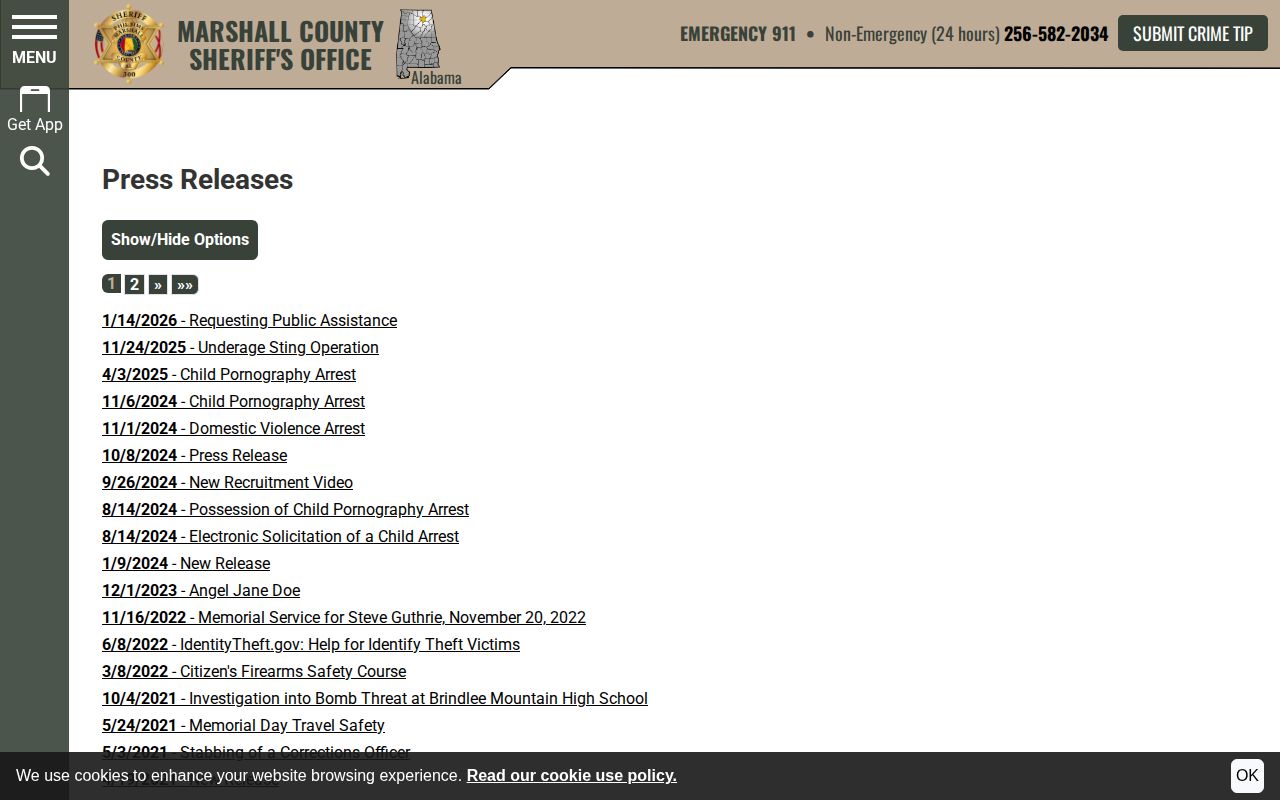
Press releases help you understand a named event and how the agency framed it. For current status, though, go to the source. The wanted profile and the court file remain the records that matter.